Sunday, June 17, 2012

A Year Later


How was it?  What did you learn?  What was the best part?  What will you miss?  Are you going back?  These are a few of the questions we get about spending our year in Italy, and I’ve been trying to figure out whether I know the answers.  Certainly I can say we’ve had a great time.  Most of our expectations were met and our plans worked out— tocca ferro (touch iron, the same as knock on wood), we’re not home yet.


We’ve learned that no matter where you go and how much research precedes your visit, there is more to see and do than you expected: music concerts, film festivals, patriotic and religious holidays, parades, museums, exhibitions, archeological and historic sites, public markets, enticing shops, places to eat and things to eat.  We’ve learned to make allowances:  for museums that don’t keep the published hours, for buses that don’t come on schedule, for motorcycles that ooze through stopped traffic like lava and erupt across intersections the instant the light changes, for concerts that never start on time, for the occasional sciopero (strike), for city noises from trams and ambulances and for occasional excess rumore (noise) from our neighbor’s TV or festa (party).  We’ve learned to get along pretty well using the Italian language, though the telephone can still be daunting, especially if you get a recorded message.  And we’ve learned to appreciate the restaurant waiters and shop clerks who let us carry on in Italian even though their English is better than our Italian.

 We happened on this medieval flag and drum contest one day at the Colosseum quite unexpectedly.

The best part of our stay has been the luxury of having so much unstructured time, of not being pressed to cram every minute with touristic activity;  so we could balance a day of museum-heavy sensory overload with one of leisurely reading or walking around the city.   More explicit “best parts” include the daily dose of church bells; the ubiquity of antique and ancient architecture, whether medieval porticoes in Bologna or random Imperial-era columns and bits scattered about Rome; and the infinity of wonderful food shops and markets with seductive arrays of produce, cheese and prepared dishes da portare via—to take away.  Then there was the day that the assistant in our local cheese shop asked Cinzia if she wanted her cheese vacuum-packed for taking out of the country.  It was so gratifying when the owner spoke up and said, “No, no, no!  È di Roma!”—She’s from Rome!

An ancient Roman column built into a wall in Trastevere.
Below, only legs remain of this Villa Pamphilii statue.

Wonderful porticoes line Piazza di Santo Stefano in Bologna.
Cheese, cured meats and prepared foods at a Florence supermercato.
Below, where Cinzia was recognized as di Roma.


What will we miss once we’re back in California?  The caffè, meaning both coffee and the place you drink it.  Not that  you can’t get a good cappuccino and pastry in the U.S., but in Italy it is hard to walk more than a block in most cities without passing at least one caffè where the service is fast and the coffee is excellent and inexpensive.  I know I’ll never find cappuccino for $1.50 once we’re home, served in real china in under two minutes by a barista who is helping half a dozen other patrons at the same time.  We’ll also miss having daily access to  open-air markets and local specialty shops where the vendors know us.  After coffee here in Florence we often stop in Piazza di Santo Spirito to buy from Rosa, who has been bringing things from the family farm just south of the city for 45 years.  And in Rome, aside from the kind cheese seller in Antica Caciara, there was Stefano for fruit and veg in Piazza di San Cosimato and the effusive signora in the pescheria there who always had a sincere buongiorno for us whether we were buying fish or not. 


Above, our regular, Baylon Caffè in Rome's Trastevere.
Below, Stefano in Piazza di San Cosimato.


Even though California has plenty of good wine, we’ll miss the super abundance of inexpensive vino available in Italy.  The wine shops and grocery stores have hundreds of possibilities, with the good ones starting at €3 and excellent vintages from about €15 ($19).  There are also shops that sell vino sfuso, where you can bring in your empty bottle and have it filled from their stainless vats.  There’s one right around the corner from our apartment.  For our “house” wines we can get quite nice Cabernet Sauvignon or Sangiovese for under €3.

Our bottles are filled at a vino sfuso shop in Florence.

Although I will admit that our area of California is culturally rich, we will miss the wealth of free and inexpensive concerts that we’ve enjoyed in Italy this year.  Bologna’s many music schools offered opera, piano and other instrumental recitals in charming settings around the city, with performers who seemed too young to be so good.  Rome has hundreds of churches with nicely reverberant acoustics, and many host visiting performers from around the world; the same is true in Florence.  (I don’t know where but in Italy we would have come across concerts for fisarmonica in every city we lived in.  We heard the woman in this link in the church of Sant’Antonio Portoghese in Rome.)

A free lunch-time concert in Palazzo Strozzi in Florence.
I can’t leave the ‘what we’ll miss’ category without mentioning gelato.  In hot Bologna last summer we ate it at least once a day, and we’re pretty much doing the same now in Florence.  We have two great shops near our apartment that both offer unusual flavors—such as melon, pink grapefruit (pompelmo rosa) or sesame with swirls of dark chocolate—for under $2 a cup.  And of course they have luscious limone, frutti di bosco, fragole, pesca and amarena (lemon, wild berries, strawberry, peach and sour cherry).  It’s much lower in fat than U.S. ice cream and has a delightful-on-the-tongue silky texture.  Yes, we’ll miss gelato a lot. 
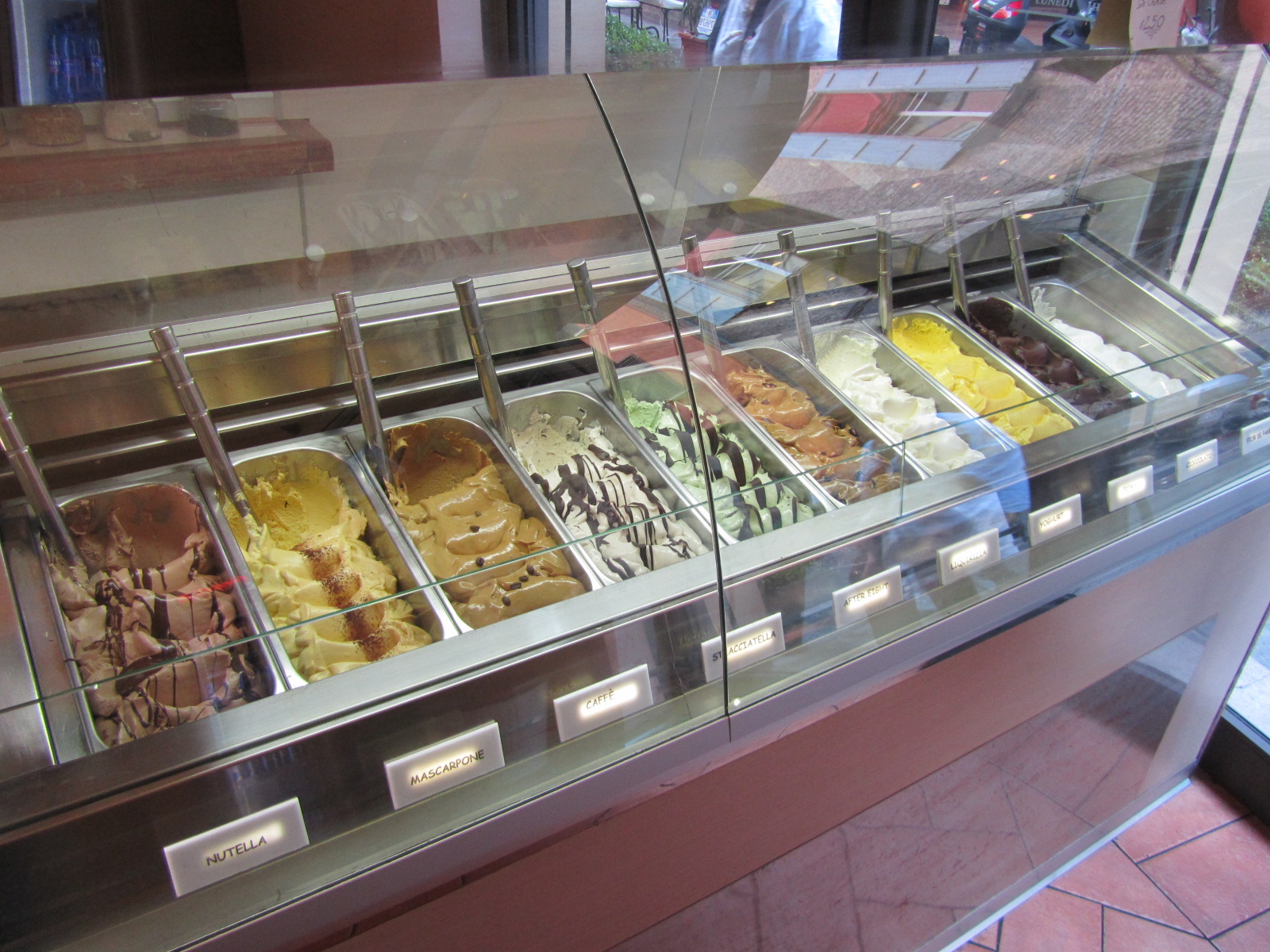
Lower fat means more intense flavors in gelato.
Not only people like gelato.
This good-mannered dog in Pisa had her own cone, which she licked just like a person would.

Several of our friends in the States have asked how the Euro economic crisis has affected us during our yearlong stay in Italy, and what evidence of it we see around us.  The answer is that for us the biggest impact has been the increase in the value of the US dollar against the Euro.  Last June when we arrived the exchange rate was $1.45=€1.00.  A year later it is $1.25=€1.00.  So at the bancomat (ATM), a €350 withdrawal costs me $70 less now.  That’s a lot of cappuccini.  


The sales tax on most things went up 1% last fall as part of the effort to balance Italy’s budget, but we can’t easily see that because the sales tax (a value-added tax called IVA here) is not listed as a separate item on receipts—it’s incorporated in the marked prices on the shelf.  The IVA rate is typically 21% (scheduled to go to 23% in Sep. 2012) and applies to almost everything.   

One commodity price that has gone up noticeably is automobile and truck fuel.  Last summer when we rented a car in Turin, the diesel was about €1.62 per liter.  Last weekend for a trip to Umbria the fuel was €1.90 per liter—about $9.00 per US gallon (including a 2¢/liter tax to help pay for earthquake relief in Emilia-Romagna).  The favorable currency exchange rate difference just about balanced the price increase for us, but Italians are paying about 17% more to fill their tanks than last year.  As a result most prices for food and everything else brought by truck to markets and stores has gone up as well, though often the rise has been so slow that it’s hard to see from day to day.

Fuel prices are one of the reasons so many Italians ride motorcycles and scooters or drive small cars.  Here in Florence there are long stretches, sometimes whole blocks of street parking reserved for motocicli, and they are often all full.  In TV commercials tonight in less than two hours I saw ads for 5 different small cars, priced between €7,900 (Peugeot “107”) and €10,125 (Ford “Fiesta”).  For a similar reason, photoelectric arrays have sprung up all over the place.  From trains and highways you can see lots of PE systems laid out in vineyards and wheat fields, on schools, factories and some houses.  We pay about $0.45 per KWH of electricity here (over 4x our U.S. rate), which may explain the lack of electric clothes dryers, the timers on apartment building stairwell lights and why some elevators cost €0.10 per ride. (Better have that dieci centessimi coin handy to drop in the slot or else head for the stairs.)

Above, motorcycles and scooters  in Florence on the Lungarno Corsini.
Below, laundry in this Trastevere vicolo is not for scenic effect but a sign of high electricity prices.

Finally, will we return to Italy?  Certamente!  Certainly!  But when and for how long a stay we can’t say.  I’d like to think this was a dress rehearsal for another lengthy stay, but economies, both ours and the world’s will have to settle down a bit first.  A permanent move to Italy doesn’t seem likely, especially considering the newly imposed worldwide wealth tax on Italian residents and the onerous bank account and tax-reporting requirements.  Meanwhile, I have over 13,000 pictures to sort through and several topics never explored that I would like to add to this journal.  So whether we’re physically in Italy or not, we’ll be here in spirit.

Roberto

Saturday, June 2, 2012

Pietre Dure


Hard stones.  That’s what pietre dure translates to in English.  What it means in the field of decorative arts is more complex:  colored semiprecious stones sliced, shaped, joined and polished to create figures, pictures and geometric designs like the one above which are inlaid into wall panels, table tops and other furniture.  It is something like marquetry, pictorial panels formed from colored wood veneers, but wood is pretty easy to cut, and it is mostly not too expensive or hard to obtain.  Pietre dure (pea-EH-tray  DO-ray), sometimes called Florentine mosaic, is made of unique slices of stone, each puzzle piece carefully selected for color, shading and patterns from among hundreds of often-rare varieties collected all over the world.  And most astounding to me is that it was all cut by hand, to a standard of perfection that seems impossible. 

Roman opus sectile wall panel, about AD 350.  Musculature was delineated by
treating edges of some segments with heat to cause a reddish darkening.

Palazzo Massimo, Roma.
The ancient Romans produced some remarkable pictures in shaped, colored stone, called opus sectile.   By the 16th century marble workers in Rome had developed the elaborate and highly precise inlays that are sometimes known as pietre tenere—soft stones—since marble is comparatively easy to work.  As the Renaissance interest in nature and art developed, members of the Medici family in Florence opened a workshop to fashion remarkably accurate pictures of birds, flowers, fruit and scenes in polished stone.  A great many of the colored stones they used were salvaged marble excavated from Imperial Roman ruins; but after craftsmen in the Florence workshops discovered methods for working them, more exotic, denser minerals and gemstones were introduced and dure—hard—was added to the description.  The Grand Ducal workshops established by Ferdinando I de’ Medici in 1588 continued to produce pietre dure for 300 years in Florence, and they still exist in the form of the Opificio delle Pietre Dure, which is both a museum and a restoration facility.  Unless otherwise noted, all my pictures were taken at the Opificio museo.


Above, a wall panel highlighting especially nice stone samples in the border.  1612.
Below, a tabletop celebrating nature.  1610-20.  
(Palazzo Pitti, Firenze.)


Aside from having some of the most beautiful and accessible examples of the art, the Opificio museo includes remnants of the old workshops, including tools and over 500 samples of semiprecious stone.  Seeing the simple iron-wire hand saws and files that cut all that rock so precisely made me shake my head in wonder.  Slices about 2mm thick (less than 1/8”) were cut from salvaged Roman decorations or from quarried blocks that might have come from India or Afghanistan.  A wire lubricated with an abrasive slurry slowly sawed its way through.  Then the slice was polished with a succession of ever-harder rock powders before being marked with a template and clamped in a vise.  The artisan then used a bow-saw with one hand and with the other fed abrasive powder onto the wire from a spatula.  He could cut about a centimeter (4/10 in.) in five minutes.  What amazes me as much as the time invested is the precision that was achieved.  The intricate joints between adjacent components are perfection.  Often it is only with great difficulty and using oblique, glancing light that the seams can be detected.

Above, stairs to the workshop museum with risers made of rare marbles.
Below, historic workbenches.  At right a wire bow saw is cutting stone inlay.


Above, the concept painting, stone selections, cutting and inserting subsections.
At bottom left are hard chalcedony and a softer lead block used with stone dust for polishing.

Above, some historic saws, files, gouges and boring tools.
Below, a few of the display cases for exotic stone.
 

The Opificio delle Pietre Dure in Florence retains a large cache of rare
 and semi-precious stone, some collected centuries ago. 

Some of this work is known as commesso, where the picture is built up on a hidden slate backing.  Landscapes and other pictorial scenes, like the ones of Painting or of the Pantheon below, were often done that way.  For tabletops and large panels the common method is intarsia, where the colored compositions are inlaid into a solid slab, often black marble, by carving out an exactly matching cavity.  Sometimes speckled, purple porphyry was the base, an incredible carving challenge since it is among the hardest of stones.   An adhesive made from pine resin and wax, applied hot, was used to glue the designs in place.

An allegory of painting from 1772.  The work on the easel was created
 by placing an actual painting behind an oval of translucent alabaster.

This corner detail shows how the trompe l'oeil three-dimensional effect
 is created in the frame, with many narrow stone strips in red-brown shades.


A "Florentine mosaic" showing the Pantheon in Rome.  Late 18th century.
Note how natural patterns in the stone add depth and texture.

Three views of an exquisite 19th-century tabletop.
Wonderful flower petal shading and a mottled seashell made from myriad fitted pieces.


Another tabletop, this one on a porphyry slab. 19th cent.
Here are a few more pictures I just couldn't leave out.  If this subject grabs you, there is an excellent book you may be able to find in a good library, Pietre Dure, Hardstone in Furniture and Decorations, by Anna Maria Giusti, translated from Italian by Jenny Condie and Mark Roberts.  Philip Wilson, 1992  ISBN 0 85667 405 2.  It is full of great color photos (that are free of the reflections that sometimes afflict mine).

Ebony storage chests similar to this one in Palazzo Vecchio in Florence are surprisingly common in museums. The pictorial panels are matte-finished pietre dure, but the framework is decorated with inlays of dyed wood, ivory and mother-of-pearl. 


The stunning 'Apollo and the Muses' tabletop in the Palazzo Pitti in Florence.  1840. 

An exuberant 3-D version of the Florence iris, augmented with tulips,
 all carved from solid semiprecious stones. 

The Renaissance patrons of this art loved sampler panels to reveal the richness
of nature's hidden colors. This little casket is a beautiful variation on that theme.
Museo della Opera (Duomo museo, Firenze)   

There are shops in Florence that sell pietre dure panels produced by modern craftsmen.  I don’t know what tools or methods they use, but to my eye they do not equal the quality of the centuries-old museum pieces.   In the Opificio museo there are 20 tabletops hung on the wall, the last commercial production of the workshop late in the 19th century, work that went unsold.  Amazing.  I would have bought one....

Roberto

Some of the 'left-over' tabletops.  Below, two other examples with detail views. 


Wednesday, May 23, 2012

The Rose Garden


When we left Rome at the end of April, one of my regrets was that I wouldn’t be seeing the wonderful rose garden in full bloom (on the lower slopes of the Aventine Hill across from the Circus Maximus).  I’m still sorry not to have seen Rome’s roses, but as it happens Florence has perhaps the best rose garden we’ve ever visited.  The iris garden that I recently wrote about is on the eastern hillside below Piazzale Michelangelo, and the Giardino delle Rose flows down the western shoulder in terraces and gentle slopes while providing entrancing views over the city.


Florence’s municipal rose garden first opened in 1895, and now has 330 varieties on show, and I really mean on show.  May is the ideal month for seeing the blooms at their finest, but what makes the garden as a whole so engaging is that it is planted in what I would call a naturalized style.  Unlike typical geometrical-plan rose gardens, this one incorporates other flowering plants, small trees, shrubs with colorful foliage, and expanses of grass with the rose bushes seemingly growing here and there at random.   


Herbaceous borders add interest.

Iris and snapdragons

Greenhouse and cultivation beds.


An amusing addition to the garden is a legacy of the late artist Jean-Michel Folon, ten large bronze sculptures, of which a few show up in these photos.  There is also a restful Japanese garden that dates from about 1995.


The giardino is open from 9 a.m. until sunset, and based on our experience I recommend Sunday morning for a visit.  Church bells from San Miniato above and from the Duomo, Santa Croce and other churches across the river made a cheerful accompaniment to the tuneful local birds. Here’s a short video to give you an idea.  If it won’t play for you or it’s missing, go to this YouTube link.


There had been a thunderstorm with heavy rain during the night before, so we were fearful that the blossoms might be ruined.  But though a few bushes had light carpets of rain-blasted petals, most were still incredible.  The multitude of buds still coming is quite amazing, both on climbers and floribunda (defined on a placard as a rose-bush with repeat-flowering blooms in bunches).   


The Pilgrim, very aromatic.
Kathleen

Varigata di Bologna


Emeraude d'Or


Helen Keller


Wait a minute, that's a peony!


Sally Holmes 
Modern Times


One of the older and most fragrant varieties, from 1892,
 Blanc Double de Coubert.


The Garland, an intensely fragrant variety dating from 1835.


I couldn’t include all the beautiful varieties we saw, nor can I squeeze in the intense aroma that perfumed so many of the bushes, so my advice is to plan a trip to Firenze in May and experience the Giardino delle Rose for yourself.  You’ll know you’re in the right place when you find this road sign with the rampant rose canes apparently following its instruction.  Then just duck in the secret gate at the bottom of the garden.


Roberto


Entrance from Viale dei Bastioni