Monday, November 7, 2011

The First Week of November in Roma


Someone suggested that I send out some random photos from Rome each week, especially if I haven’t got a more topical episode ready to post.  So here are snippets from last week.

We heard Mozart’s Requiem presented in the church of Sant’Ignazio di Loyola, with orchestra, organ, soloists, and a choir from Germany.  Unlike some church concerts, this one was very well attended, and also unlike some churches, this one has excellent acoustics—just the right amount of reverberation time.  Maybe that’s because the vaulted ceiling isn’t as high as it looks.  The trompe l’oeil painting makes the unusually shallow barrel vault look much higher.  If you look carefully at the left end wall, you can see where the structure really is, just above the window.  The imaginative architecture and characters that seem to float out into space have been surprising church-goers here since Andrea Pozzo created the fresco in the late 1680s.

The nave vault of Sant'Ignazio di Loyola a Campo Marzio

November 1, Ognissanti (All Saints’ Day), is a national holiday in Italy, and when we went to the expansive and woodsy park of the Villa Borghese we found a great many Romans out for the day, many with children along.   But there were those who preferred the ambience of boating nel lago (on the lake) near the Greek temple.
We had come to the Borghese to see two of the Rome Film Festival showings, but we had time between them to both stroll the park and visit the Galleria Borghese, home to some of Gianlorenzo Bernini’s most striking sculptures.

The palloncino vendor was doing good business.

A great place for barche a remi (rowboats).

This documentary was about how Italians remembered
 Christmases past and how they expected things would go now. 

Pluto assaults Proserpine in the Galleria Borghese.

One of the best things about living here is that we have time to poke around and sniff out great shops and food.  In this case it’s a great food shop, and sniff is exactly the right term.  Here’s a picture inside Innocenti Biscottificio, where dozens of freshly baked varieties of cookies, meringues and the like are sold by the kilogram.  We think this may be one of the best shops we’ve ever found.
Baked goods wherever you look.  Yum!

We get lots of exercise walking, but to keep everything ticking over properly I try to make a couple of circuits a day up the Gianicolo (Janiculum Hill) from our apartment at its base.  There are several routes, but the one I go up most often has this scala (staircase) at the top.

How many steps will earn me a biscotto?

Near the end of the week we went to our last Film Festival show, this one at the main venue that had red carpets and a fair amount of glitz.  The movie we saw was a French noir thriller called Nuit Blanche—high tension from beginning to end.  Just as we came out of the theatre, we found that Richard Gere and his wife were arriving for a special presentation and award.  I tried for a picture of him, as did the rest of the crowd, but was jostled too much.  But here’s what the scene looked like just before he came into view.

Lights, cameras.....

Yesterday afternoon was bellisima.  Here’s Il Fiume, the river, with the small island of Tiburina at the right and the Ponte Cestio connecting to Trastevere on the left.  The bridge is named after the ancient Roman Cestii family that built the original version of it in the 1st century BC.  This one dates from about 1892 when the massive enclosing concrete walls were built along the Tiber to control flooding.  A couple of weeks ago when Rome had its nubifragio (cloudburst), the river covered the walkway around the island and lapped at the bike path.


Torno subito.
Roberto

Saturday, October 29, 2011

Bel tempo, mal tempo


On the whole we’ve had beautiful weather (bel tempo) since we arrived in Italy.  In June and July we had an occasional thunderstorm in Bologna, mostly at night.  Sometimes it was quite hot, and we went months without taking a jacket or sweater out of the closet, but we were never inconvenienced by rain.  The same has held here in Rome with clear, bright days, though the change of season has brought cool nights.  However, just over a week ago, on October 20th, Rome was blasted by mal tempo, as a monumental cloudburst (nubifragio) from a strong thunderstorm (temporale) caused disruptive floods (alluvione, inondazione, diluvio) in several parts of the city.  Trastevere and most of Rome got 127 mm (5 inches) of rain in under three hours.  Several Metro subway stations, including the critical one where the lines cross at Termini Station, were closed by water pouring through vents and down stairwells.

Some of the flooding in Rome on October 20, 2011

We’re up quite a bit from those low areas (many were swamps and marshes centuries ago), so we didn’t get that kind of trouble, but water pouring off the Gianicolo hill went racing down our street, and high winds brought down some tree limbs.

A river floods down Via Luciano Manara

Wind-fall on Via G. Mameli at the base of the Gianicolo

What happened here is nothing compared to what blasted the Liguria region of Italy south of Genoa on October 25th.  The beautiful Cinque Terre coastal villages were struck by horrible flooding of water and mud (fango) and landslides (frani).  These pictures from news outlets give an idea of the damage.  Here’s a link to video of the flood through Monterosso al Mare, the northernmost of the Cinque Terre villages, and you can look at others like it that appear with the link.

This is what Vernazza, one of the cinque terre,  looked like before this week's storm.

Here the flood is in full spate.

These two show aftermath.  Look at the gloop in the railway tunnels.


There have also been floods and landslides down near Naples and snow above 1000 meters up north.  An Italian geologist/climatologist on TV the other day said the increasing amount of extreme mal tempo here is the result of  global warming, and I won’t say he’s wrong.  But today in Rome it’s another bel giorno, high near 21°C (70°F), low tonight 11°C (52°F), some puffy clouds drifting by now and again, and the forecast (previsione) is for more of the same tomorrow.  I’ll take it while I can get it.

Roberto

Thursday, October 27, 2011

Trastevere

The region of Rome where we’re now living is called Trastevere (trahs-TAY-veh-ray), which means “across the Tevere.”  Although the ancient Romans called the river that flows through Rome Tiberis, and we still call it the Tiber, sometime in the dim past Italians started calling it Tevere.  What Trastevere is across from is old Rome, the centro storico where you’ll find the ruins of the Roman Forum, the Colosseum, the Pantheon and many of the other sites we associate with the city.   Vatican City is on our side of the river, upstream just to the north.  To the west beyond most of the commercial and residential development, the land rises sharply to form the Janiculum Hill (Il Gianicolo).  Some heroic battles of Italy’s 19th-century unification struggles took place up there, and from overlooks amid patriotic monuments in the ridge-top park there are spectacular views over the city—and you can watch the noon cannon being fired.


General Garibaldi, military leader of Italy's 19th-century unification battles.

Busts of notable Italians from all fields line paths in the park atop the Gianicolo.

St. Peter's and Vatican City, looking northwest from the Gianicolo.
Looking east from the Gianicolo.  A line of trees and a curved building mark the River Tiber. 

Every day at noon the army fires a cannon from the Gianicolo so that all the city
church bells will be coordinated.  The day I took this picture the church bells started early....


We have been having a good time exploring our immediate neighborhood—figuring out whether one of the 10 bar/caffès within five minutes-walk of our apartment is the best; making the acquaintance of food vendors in the daily open-air market in Piazza di San Cosimato; testing the products of various pasticcerie, biscotterie, and pastifici (pastry, cookie and fresh pasta shops); and discovering likely ristoranti and other types of shops.  Though the tourist crowds are diminished at this time of year, by evening the narrow medieval streets are invitingly alight and people are out and on the lookout for just the right trattoria, gelateria or enoteca (wine bar).

A few of the places for coffee within five minutes walk of our apartment.

Morning scene along the west side of Piazza di San Cosimato

Piazza di S. Cosimato.  The big sycamore tree shades a well-used playground.
The daily fruit, veg, meat, cheese and fish market is to the right.

One of six or eight produce vendors in P'za di S. Cosimato.

This old-style pasticceria also makes hand-dipped chocolates
and Sicilian sweets (below) as well as giant chocolate Easter eggs
.


Innocenti Biscottificio makes dozens of varieties of delicious cookies.

This mouthwatering pile of whipped cream-filled profiteroles bound by thick, rich chocolate,
 came from Trastevere Pasticceria di Fabrizio Mattei, six minutes away from us.  I timed it.

Street vendors along Viale di Trastevere.

Setting up for pranzo.

Night scene in Trastevere.

As perceptive readers of this journal will have noted, ancient structures and fine art are like magnets to us.  Some of Rome’s oldest Christian churches are in Trastevere and contribute in both categories.  And there’s an ancient Roman aqueduct up on the Gianicolo along with ruins, fountains, city walls and villas from many eras.  Though little from antique Rome survives above ground in the lower reaches of the district, there are medieval buildings to be found, and some original sections of the ancient Via Aurelia paving remain in modern Via della Lungaretta (see the map above).  So we’ve been busy taking closer looks at our local sites, and I expect some will appear in future articles here.

The present church of Santa Maria in Trastevere, with 12th-century mosaics on the front,
replaces one built in the 4th century AD.

A Roman aqueduct, restored in 1612 and still in use,
 runs over the top of the Gianicolo from the west.

Villa Doria Pamphili is also on the Gianicolo.  The grounds make up Rome's largest public park.
The perimeter is about 19 km.

Speaking of future articles, we’ve been living in Rome for over three weeks now, yet I’ve been unable to get together a blog entry since we arrived.  Why is that?  Partly it’s because Rome has been consuming, offering so much to see and do that days and evenings get filled up.  Even though we’ve seen many of the historic attractions during past stays, there are always more, and many of those ancient places call to us over and over.  In addition there are countless current events:  concerts, theater and opera productions and other unexpected exhibitions and presentations.  For example, the International Rome Film Festival starts this week.  The descriptive catalog alone is 107 pages long.  Luckily we don’t feel drawn to all the films, but sorting out the ones that do sound good and trying to work them into our calendar and budget is a job in itself.  Then, since Rome is big and busy, we have to allow 20-to-45 minutes travel time each way on public transit. 

The frequent trams of line #8 run up the center of Viale di Trastevere
and take us over the river to the centro storico.

Lots of public transit routes but not always enough frequency
can make for crowded trips.

The catalog for the film festival and our tickets.

I have also been taken aback by the volume of information already posted online about Rome, its history, and artifacts—surprise, surprise, others have been here before me.   There seem to be blogs and websites describing every market, food store, restaurant, fountain, statue, church, painting, mosaic, ruin, bridge, road and edifice, including those still buried or no longer existent.  So at first I wasn’t sure I had much to add.  But now I find that not everyone sees things the way I do or is as easily amused, so on we go.

Roberto
Mounted police ride up Via Goffredo Mameli outside our apartment.
Mameli wrote the words to the Italian national anthem and died after one of
the battles on the Gianicolo in 1849 at age 21.
Sunday, September 25, 2011

Bononia

This weekend in Bologna the city was celebrating Archeopolis, the 2200 years of Bononia.  During ancient Roman times, Bononia was the name of the city founded here in 189 BC.  The name probably derives from the Celtic tribe that lived here with the Etruscans before Rome came along, the Boii.  The city is also celebrating the 130th anniversary of the civic museums, so all the museums were free, too.

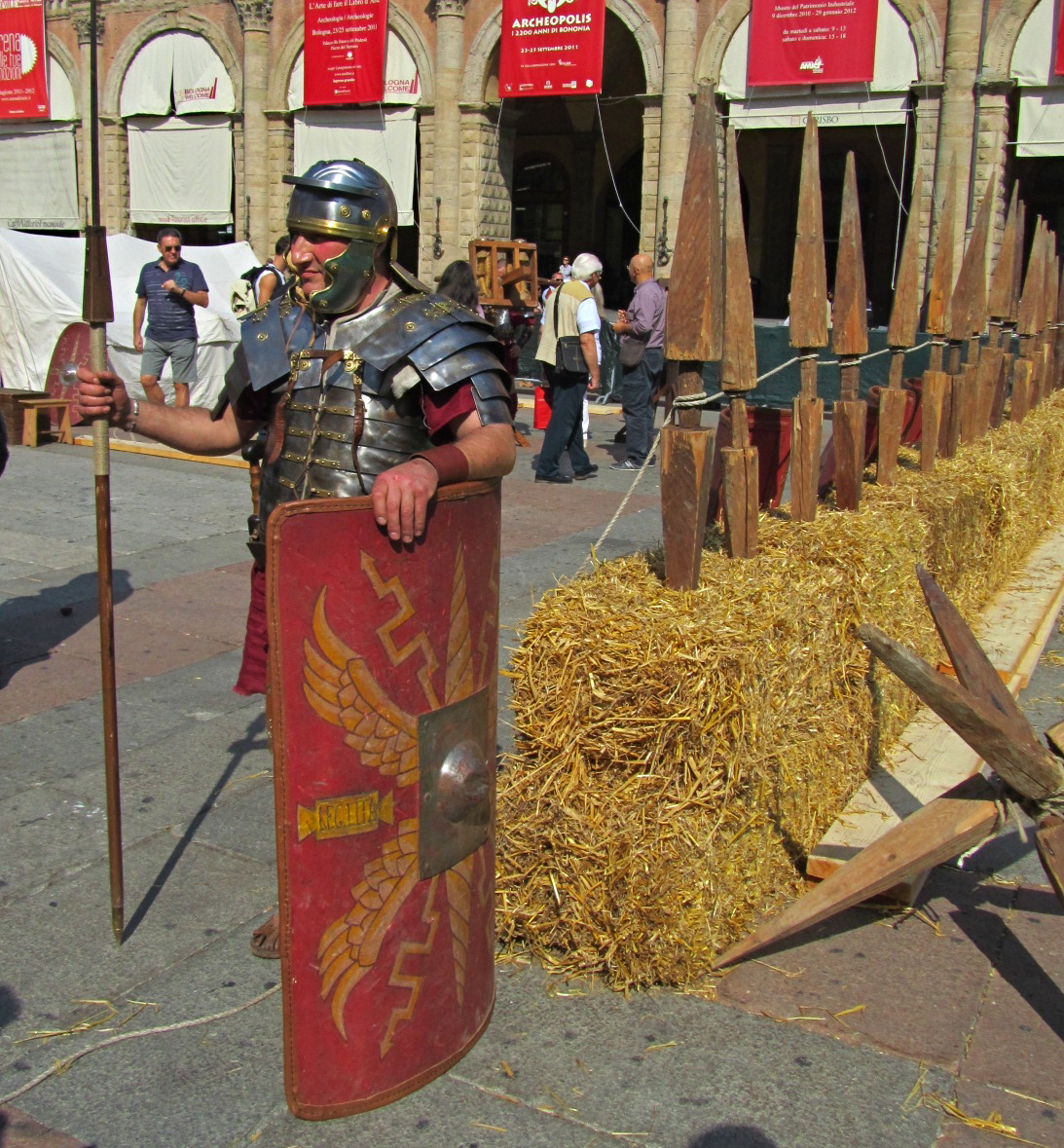
As a reminder of the antique patrimony, a Roman military encampment from the time of Nero (1st c. AD) has been created in the middle of Piazza Maggiore.  By coincidence, the restoration scaffolding that still hides part of the front of the Basilica di San Petronio was opened to the public starting Saturday.  So for €3, one can climb the steel stairway behind the decorative graphic shroud, getting a very close look at the building on the way up and previously impossible views from the top platform, 75 feet above the piazza. 


Pigeon's-eye view of San Patronio portal arch carvings.
Roman camp recreation in Piazza Maggiore from San Petronio scaffolding.

The camp is peopled by men (mostly) whose hobby is recreation of that period.  The uniforms and everything else are as accurate to the era as possible, and small displays within the precinct show the skills and specialties involved.  A couple of times a day the troop forms up and marches, then creates the testudo defensive formation in which the semi-cylindrical shields are held above and slightly overlapping to create a tortoise shell over the entire group.  It is a tactic credited for many Roman military successes.  I missed getting a picture, but I’ve plopped in one from the Internet.

Legionary re-enactors of Bononia


The testudo, or tortoise defensive formation.
The public is invited to view the Roman encampment.


Two ballistae and an onager, siege weapons that are powered by twisted rope tension.
Onager means wild ass, which describes the bucking of the machine when fired.
Soldiers and their helmets.

Shield and armor maker and some of his equipment.
Grain, fruit, vegetables, nuts, spices, wine, oil, bread.
Carry or scavenge everything.

Parts of the body were thought to be controlled by various deities,
but they could be influenced by various doses and annointments.

The aenetore uses a buccina to mark the hours.
Below he holds a cornu for issuing commands.
 

The camp commander in his tent.  A few more comforts.

The Bologna Archeological Museum is full of Roman artifacts.  Here are a few of the bits and pieces of ancient Bononia that have come to light here in modern times.  
Water spouts and valves.

Medical instruments.

Glassware.

Maybe the most prominent remnant of the Roman period is the basically rectangular street layout in the center of the city.  Strada Maggiore, which follows the Roman  via Aemilia, runs straight as can be through the center.  
Strada Maggiore heading east from centro.
(Viewed from the Torre Asinelli.)
But because the city has been constantly inhabited and always heavily built up, remains of Roman buildings are uncommon.  An ancient theater was found during reconstruction excavation between via Barberia and via Collegio di Spagna, some original paving stones can be seen near the Medieval Museum on via Manzoni, and we saw Roman foundations below the streets on our tour of acqua sotto le strade, but most findings have come from outside the old walls.  So it's appropriate that we get a reminder of some distant history that's not quite as obvious as its medieval and later descendants.

Roberto