Monday, May 21, 2012

Mille Miglia


From 1927 until 1957 there was a sports car road race in Italy called Mille Miglia (thousand miles).  After a tragic accident killed bystanders and a driving team the race was no longer run.  But for many years there has been a replacement of sorts, a time-trial road rally for cars built before 1958, still called the Mille Miglia (MM) and still roughly following the 1000-mile figure-eight course through Italy from Brescia in the north to Rome and back.  It is no longer a high-speed race but a series of time and distance challenges where the driving teams try to come as close as possible to the average speed between checkpoints designated by the organizers—about 50 km/hr (31 mph), which includes slow passages through historic town centers.  For many of the older cars it is also an endurance test.

Over twenty years ago we happened to see the Mille Miglia as it went through ancient Siena, the throaty exhaust rumblings echoing through the narrow stone-walled streets and the exotic aerodynamic car shapes of the 40s and 50s making an engaging contrast with the medieval surroundings.  So when we found that this year the rally would be going through Florence we were eager to see it.  Of course things change in twenty years, and a difference this time was the intermixing of several other car rally groups with the 387 official vintage cars.  There was a Ferrari Tribute rally with 140 cars (an official part of the MM program), some Mercedes and Porsche club cars, a big gathering of Triumphs, and at least two vintage car touring groups that merged in as well.  Add to that the city buses, taxis, bicycles and hordes of free-range pedestrians and you’ll begin to see the scene.


The rally route ran past the Palazzo Pitti (Pitti Palace, shown above), very near our apartment.  Although the Ferraris started out ahead of the vintage cars, in the miles and hours en route from Rome some order was lost.  The hot cars started passing by us shortly after mezzogiorno (noon), the old racers about 2 pm, and they didn’t finish until nearly 5 pm, by which time a light rain had arrived.

A few of the Ferrari rally cars.  Above an F40.
Below,  2009 Scudria Spider 16M,  2012 SA Aperta,
  2011 458 Spider, and 2012 FF


The photos below are a small selection of the hundreds of cool cars we saw.  (If you visit the official Mille Miglia site you can see pictures of all 387 old cars and discover lots of rally particulars—such as the registration fee:  €7260.  The list of Ferraris is here.)  

Above, 1930 OM 665 and a 1925 Bugatti Type 35A.
Below, 1933 Fiat 508 S.

Above, 1928 Bugatti Type 43.
Below, 1938 Lancia Astura.


Above, 1926 Bugatti Type 35A.
Below,  1933 Aston Martin Le Mans.

Above, 1932 Alfa Romeo 8C 2300.
Below, 1937 BMW 328.
 

Above, 1929 Mercedes E 720 SSK.
Below, 1950 Jaguar XK120 OTS.

Above, 1950 Fiat 500C Coupe, front and back.
Below, 1935 Mercedes E 500K.

Above, vintage cars enter Piazza della Signoria.
Below, 1937 BMW 328.

Above,  1951 Bandini 750 Sport.
Below, Gullwing Mercedes, old and new.
 

Above, 1955 Ferrari 250GT, front and rear.
Below, 1953 Jaguar C-Type.

Above, 1948 Fiat 1100 S.
Below, 1953 Ferrari 250 MM.
Inset shows radio transponder for auto-checkpoint reporting.

I also cobbled together a video to give some sense of the event.  As you will see, crowd control was minimal.  If the the video is missing below or won’t play for you, go to this YouTube link.

In the video after the opening shots with Ferraris going by, the first set of cars viewed at street level are:

#6    1928 OM 665 Superba (an Italian company in Brescia that first made railway cars)
#98    1939 BMW 328, Mille Miglia veteran
#27    1926 Bugatti Type 35 T
#5    1927 OM 665 Superba
#67    1933 Aston Martin Le Mans
#72    1931 Alfa Romeo 6C 1750 GS
#100  1937 BMW 328, Mille Miglia veteran
#599  2011 Ferrari 458 Spider

After that, you’re on your own, though the #142 car at minute 4:14 is a 1950 Patriarca 750 Sport.


Finally, in the making limonata da limoni tradition, if your 1954 Jaguar is going to break down, it might as well be in front of a gelateria. 

Roberto


Saturday, May 12, 2012

The Iris Garden

A little-known and short-lived floral extravaganza is underway right now in Florence.  The Giardino della Società Italiana dell’ Iris (Garden of the Italian Iris Society) is open to the public while the vast plantings of bearded iris (iris barbate) are in bloom.  (April 25 – May 20, 2012) 


Begun in the mid-1950s as the site for an annual international competition for the best iris variety, the garden is set among olive trees that range down the eastern shoulder of the slopes below Piazzale Michelangelo.   Growers from around the world send rhizomes to Florence where they are cultivated for three years before being judged.  The 56th annual Il Premio Firenze competition is being judged now, with the winner to receive a gold Florin.  

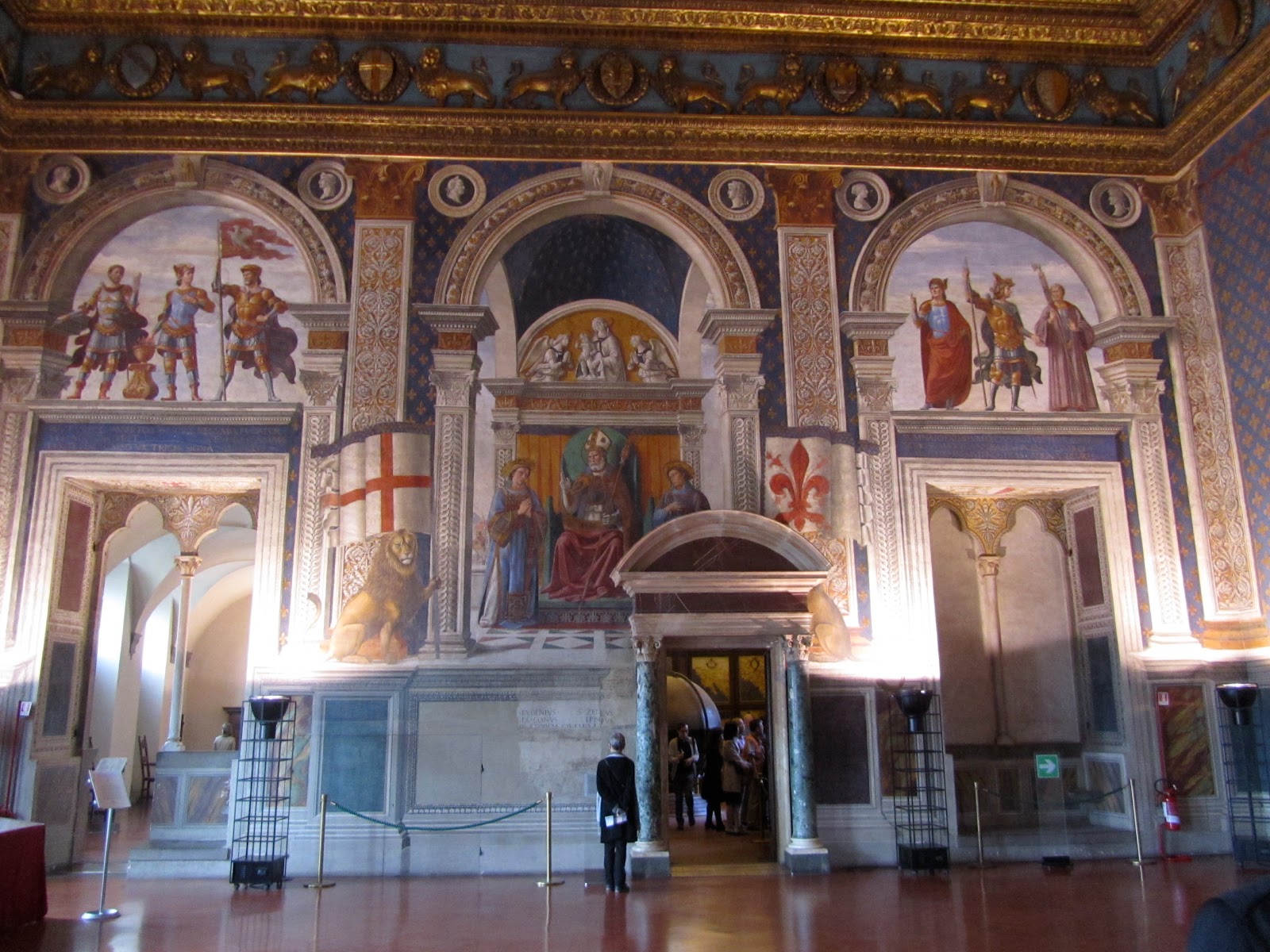
One reason Florence was first chosen to host the competition is the belief by many that the emblem on the city banner is not a lily–the fleur de lis–but rather a red iris.  So there is also a special award given each year to the red iris that best embodies that image. 

One of the oldest depictions of Firenze's floral emblem
is painted in the so-called Lily Room in the Palazzo Vecchio.
Below, an enlargement.  A Lily or an Iris?

Each year a new planting bed is cultivated for the arriving iris hybrids, and they seem to remain for at least ten years after their show date.  The older beds are still producing some beautiful flowers, but the 2011 and 2012 beds are ablaze with spectacular blooms.  Below are some photos taken last Tuesday.  If you happen to be in Florence this week, catch the #12 or #13 bus to Piazzale Michelangelo and enjoy the garden yourself.  More information is here.

Roberto

An older set of hybrid iris, some still vigorous and beautiful.

Looking northeast.


The competition bed for last year, 2011.


A judge works through the 2012 abundance.


Not everything is an iris.  Here is a bed of Aquilegia (Columbine).

Wild red poppies certify springtime in an uncultivated patch among old olive trees.
Roses also bloom among the trees.

Friday, May 11, 2012

Firenze


The historic center of Firenze.

The end of our year in Italy is in sight, sad to say (siamo molto tristi), and for the final two months we have moved to Firenze, that is, Florence.  Our apartment here is in the Oltrarno—across the River Arno—not far from the Pitti Palace and the Boboli Gardens.  This puts us out of the major press of tourist crowds and into a neighborhood still largely populated by “real” Italians and home to shops of traditional artigiani, antique dealers and negozi praticali (stores for necessities like food and hardware).  Just around the corner (a due passi, two steps away) is the charming, leafy piazza fronting the church of Santo Spirito.  Most mornings after cappuccino at Caffè Ricchi we buy garden-fresh vegetables and fruit from one of the small vendors in the piazza.

The Oltrarno district is to the left.   The Ponte Vecchio is the foremost bridge.

The unusual façade of Santo Spirito rises beyond its piazza.

Caffè Ricchi in Piazza S. Spirito. 

This vendor sells us fruit, vegetables and flowers,
many from her own gardens just south of Firenze.

Florence is different from Rome in several ways.  Rome is vibrant, almost frantic with activity, traffic, tourists, and buses.  There's so much to do and see that you could spend years and years.  The streets are lined with structures that range in age over thousands of years.  Next to an apartment building dating from the 1920s there might be a 5th-century church sporting renovations from the 9th, 13th, 16th and 17th centuries.  And just down the way there could be an ancient Roman wall from 150 BC or Roman columns built into the outside of a medieval house.  There is also a Roman attitude that's not easy to put into a few words but can sometimes be seen in a tendency toward intense discussions and a certain attitude of entitlement—though every individual Roman we dealt with was wonderfully friendly, helpful and had a good sense of humor.

Unlike Rome, Florence doesn't have much truly ancient architecture, so it looks a bit more homogenous, though still charmingly old to American eyes.  There are lots of buildings from the 15th century and later, but few older than 11th c.  There was a Roman community here, Florentia, but it was small and most architectural remains are buried, though the forum expanse and primary crossroads persist at the Piazza della Repubblica.  

Via Maggio with Renaissance-era palazzi.
Below,  examples of sgraffito,  designs cut and colored into wet stucco.
This is the 16th century Palazzo di Bianco Cappello.


A flower market within the main post office portico.

The majority of the city center is off-limits to most cars, so even though there are a zillion tourists, they can often use the whole street for a walkway—but watch out for bicycles.  The north of Italy is also better off economically, and law-enforcement seems more assiduous here, so there are fewer beggars and homeless to be seen.  The historic center is also much smaller than Rome's and seems to have a somewhat lower percentage of tourist souvenir shops, though if you are after anything made of leather there are hundreds of shops and market stalls to choose among, and every high-end international apparel company in the world appears to be represented within a few blocks of the Piazza della Repubblica.  In the area around our apartment are lots of antique shops but also quite a few small workshops (laboratori) where old men (mostly) are repairing furniture or creating elaborate carved picture frames.  There's a 16th-century ex-palazzo across the street used as a storehouse for one of the dealers, and through the ancient window bars can be seen hundreds of elaborate crystal chandeliers hung from the beams.

Looking toward the Piazza della Repubblica.
A police presence...

Leather goods in the Loggia del Mercato Nuovo.

Crystal chandeliers in an antiques storeroom along Via Maggio.

Moving to Florence means a shift in historical emphasis for me. Re-focusing from ancient Rome to the Renaissance means learning or re-learning a lot of art history and politics, but I’m getting there, replacing my lists of emperors and popes with the Medici family tree.  On the other hand, the food transition has been easy.  The pastries are different but excellent.  We haven’t seen Roman-style artichokes (carciofi alla romana) in the markets or ristoranti, but Tuscan specialties are plentiful, so I see a bistecca fiorentina in our near future.  And there’s a gelateria on almost every corner, so life is good.

Roberto
Gelateria Santa Trinita, just down the street.

The River Arno at dusk.